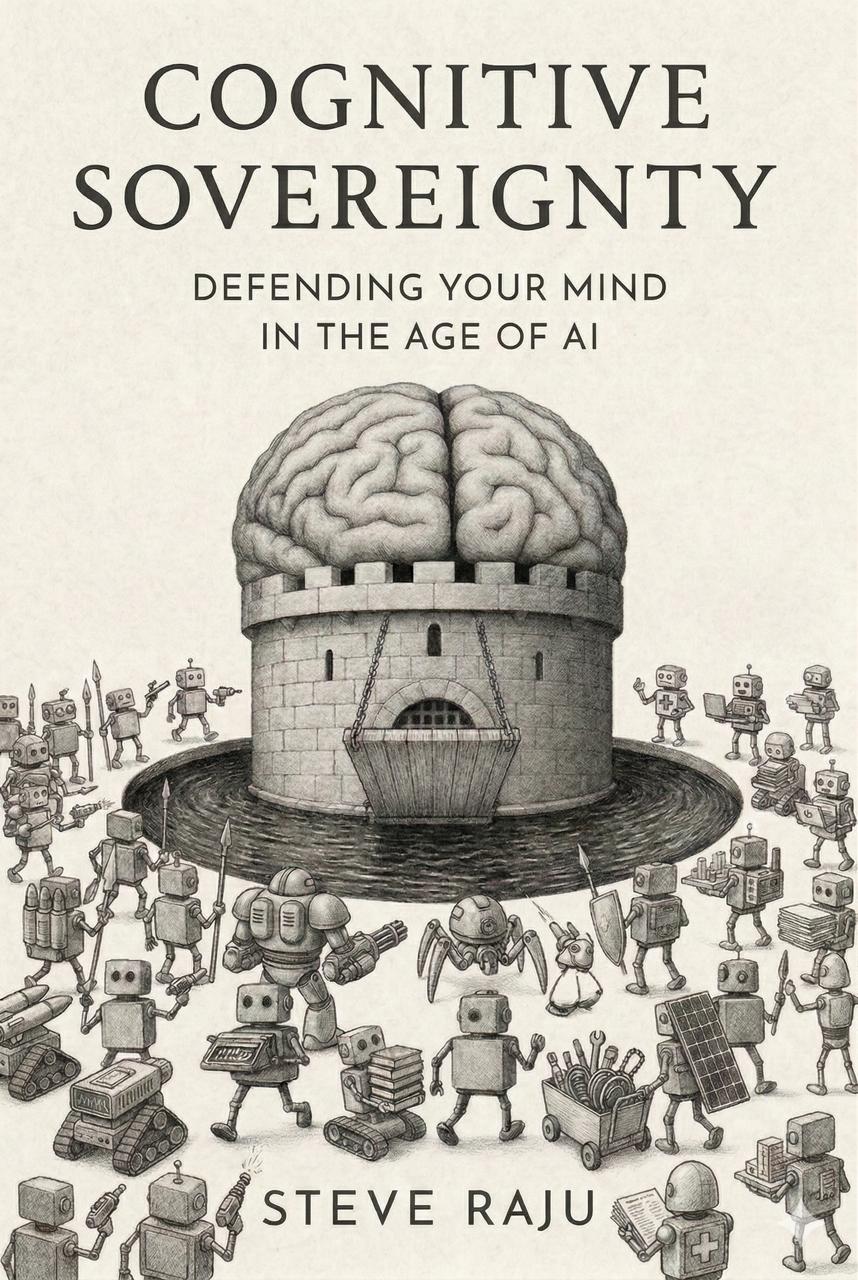
New book · April 14, 2026
Cognitive
Sovereignty
Defending Your Mind in the Age of AI
Why this book exists
A gecko named Frank nearly died from comfort. His obstacle course was too easy. He ran it so many times he stopped running it at all. Stopped eating. Stopped moving. His owner thought he was dead. He wasn't — he was just quietly atrophying in a warm tube that asked nothing of him.
A researcher at the University of Tokyo gave two groups of people GPS devices and paper maps and tracked them for six months. The GPS users came back with 62% less spatial memory. Their hippocampi had physically shrunk. Not metaphorically. On an MRI. They didn't just forget how to navigate — they lost the capacity.
That study was 2017. Before ChatGPT. Before Claude. Before AI that doesn't just store your information but does your thinking, writes your arguments, generates your ideas, and — if you let it — slowly turns your brain into a very expensive autocomplete.
"Each individual surrender is small, reasonable, and obviously correct. We barely notice we've made a choice at all. What results looks less like a crisis than water damage in a basement."
Every book about AI tells you how to use it better. This one asks a different question: what is it doing to the parts of you that can't be replaced?
Your ability to think critically. To create something genuinely new. To sit with a hard decision and own it. These aren't productivity features. They're what make your thinking yours. And they atrophy. Fast. Without you noticing.
This is not an anti-AI book. It's a book about fighting back — smartly, strategically — before the cage closes and you don't even miss what you've lost.
The central idea
When you still look like you're thinking for yourself — but the actual thinking stopped happening somewhere around six months ago.
During the Cold War, "Finlandization" described countries that kept their flags and their parliaments — but deferred to Soviet influence in every decision that actually mattered. Independence on paper. Dependency in practice.
The same thing is happening inside millions of heads right now. You're still writing. Still deciding. Still signing your name on things. But ask yourself honestly:
When was the last time you wrote a first draft that was entirely yours?
Problems don't get thought through anymore. They get typed into a box. You've forgotten that's a change.
You produced the document. But if someone pushes on the reasoning, you're already reaching for the tab.
That two-minute discomfort before an idea forms? Intolerable. The cursor blinks once and you're gone.
You read it, it sounds right, you move on. The part of your brain that used to say "wait, really?" has gone quiet.
Inside the book
The Comfortable Cage
How convenience degrades capacity — the neuroscience of cognitive atrophy and why it's accelerating.
Mapping Your Cognitive Nation
The four territories most at risk: critical analysis, creative thinking, metacognition, and complex decision-making.
The Superpower Next Door
What AI actually is — a pattern-completion engine, not a thinking machine — and why that distinction changes everything.
Cognitive Finlandization
The warning signs that your intellectual independence is becoming nominal. How smart people lose it without ever deciding to.
The Finland Doctrine
A three-principle strategy for engaging with AI without being absorbed by it.
Defending Your Borders
Specific practices for protecting critical analysis and metacognition — the gatekeeper capacities.
The Creative Frontier
Why letting AI generate means you never develop the taste to evaluate. How to use it as a sparring partner instead.
The Judgment Seat
On decisions that cannot be computed. Why outsourcing judgment to a recommendation engine isn't efficiency — it's abdication.
The Sovereign Mind in Practice
Daily habits, AI-free zones, first-draft-independent protocols. Moving from passive dependency to active partnership.
Beyond the Border
Why cognitive sovereignty will become a rare and valuable virtue — and why the time to protect it is now.
Is this book for you?
The author
Steve Raju has spent his career watching what technology actually does to people — not in theory, but up close. He started as a programmer, shifted into copywriting and marketing, and for the last several years has been helping businesses adopt AI as a consultant.
That last job is what made this book necessary. When you spend your days getting companies excited about AI, you also spend your days watching the human side of the equation go unexamined. People optimising for output while something quieter heads the other way.
He completed Stanford's Machine Learning Specialization, runs Conversion Pioneers, and lives in Vancouver with his family. He is not on a digital detox. He uses AI constantly. That's the point.
It opens with a gecko. It ends with a question you won't be able to stop thinking about.